ViperMesh was faster on six comparable live Blender tasks.
Benchmarking the ViperMesh Blender MCP
I benchmarked the ViperMesh Blender MCP and its agent harness against the original community BlenderMCP baseline, with evidence from live tasks, reduced token usage, visual scoring, and the Harneloop evidence loop.
Why Part One? This study evaluates the Blender MCP and its benchmark harness specifically. The wider ViperMesh Studio, browser workspace and neural 3D generation tools were not benchmarked here; they are separate parts of the product.
ViperMesh is a unified workspace for 3D artists and engineers.
The product is being developed as an end-to-end 3D studio where people at different experience levels can move from an idea or source asset to a finished project without assembling a separate application and subscription for every difficult stage. It brings connected workflow planning, AI-assisted creation and modification, Blender automation, asset inspection, and delivery tools into one workspace.
Connected 3D workflows Queue procedural, neural, and manual stages while retaining project assets and run history.
Browser-based 3D workspace View, inspect, and interact with generated or imported models through ViperMesh's browser-based 3D viewing and rendering surface.
AI model tools Create and modify meshes through integrated neural tools and models, including Hunyuan3D and TRELLIS workflows.
Blender MCP and agent workflows Manipulate Blender scenes with natural language through a purpose-built, deterministic tool surface and artifact checks.
The Blender MCP is one part of the wider ViperMesh workspace. It is engineered to use fewer tokens, finish repeated operations faster, preserve inspectable actions, and reduce hallucinated Blender Python through narrower tools and scene validators. The published evidence on this page compares it with the Anthropic x Blender MCP server. A scored claim against every other open-source connector is not made here until those comparisons have the same evidence quality.
Benchmark boundary: the measurements on this page cover only the ViperMesh Blender MCP and the benchmark harness used with it. The wider studio, browser viewer, and neural 3D tooling are product context and were not evaluated in this study. That narrower scope is why this is Part One of the case study.
Public and private boundary: the full ViperMesh product repository is private. The core Blender addon and persistent MCP connector remain open source so the local connection, deterministic operations, scene validation, and agent integration can be inspected independently. The historical benchmark configuration included its own guidance and available assets; it is not a claim that the public addon bundles private Studio asset libraries.
The harness was built from observed failures, not from one prompt rewrite.
ViperMesh is the project where I learned the core agent-engineering practices that now shape Harneloop. Each architectural step responded to a repeated failure in tool use, spatial reasoning, scene inspection, or artifact evaluation.
- 01 Local product bridge
ViperMesh began as an Electron client for a local Blender-connected vertical AI product. The desktop architecture provided a practical bridge while I was learning browser-to-local-service constraints.
- 02 Prompt and code experiments
The first agent used a custom ReAct-style cycle, system prompts, few-shot examples, and researched execute_code scripts before I adopted LangChain and LangGraph.
- 03 Failure diagnosis
Benchmark artifacts showed that spatial reasoning, scene inspection, and hallucinated Blender Python parameters were the recurring failures, not only prompt wording.
- 04 Deterministic addon
I rewrote the Blender connection around roughly 130 parameterized tools so common scene operations no longer required fresh Python generation.
- 05 MCP and product expansion
The MCP layer now helps agents select the right tools and context. The wider ViperMesh roadmap connects this Blender agent to other addons and neural 3D generation workflows.
Across the seven comparable live and agentic benchmark runs.
83.333 vs 75.143 average score from the neutral LLM judge rubric.
175,158 versus 1,927,483 acting-agent tokens across all seven benchmarks.
Executive summary
Benchmark results and one exception.
The first ViperMesh case study evaluates whether a purpose-built Blender agent
harness can outperform the Anthropic x Blender MCP server baseline
on practical scene-building tasks. The strongest measured signal is not only speed.
ViperMesh reduced broad execute_code dependency, preserved complete
command traces, and gave the benchmark loop enough evidence to find visual and
spatial mistakes.
The result is intentionally scoped: ViperMesh won six of seven comparable live tasks and had the better mean speedup, but the Anthropic x Blender MCP server baseline was 34 ms faster on the rotated-copy task. Reduced token usage is calculated from aggregate local acting-agent token telemetry across all seven benchmark runs, not final provider billing. Visual scores are preliminary and based on seven live render pairs scored across four criteria.
Benchmark dashboard
Speed, determinism, reduced token usage, and visual quality
The page uses the chart dataset from the local ViperMesh case-study evidence bundle. The comparison target is the Anthropic x Blender MCP server baseline. Both harnesses used OpenAI GPT 5.5 High as the acting model, so the comparison isolates the harness and tool surface rather than a model mismatch. The charts below use measured elapsed time, aggregate acting-agent token usage across all seven benchmarks, and neutral LLM judge visual scoring.
Live benchmark performance
Actual elapsed time for each comparable live task. Lower is better. The paired bars use one shared 0-14 second scale, so the gap is visible without converting either harness into a derived score.
6 / 7
ViperMesh faster
2.534x
mean speedup
10.149s
largest observed gap
ViperMesh Anthropic x Blender MCP server
Broken workstation repair
Desk corner corrected
Market stall structure canopy
Multi-hop spatial relations room
Occluded storage clearance
Rotated copy not mirror
Sci-fi console cable routing
Visual evaluation
+8.19 pts neutral LLM judge rubric lift
ViperMesh / Anthropic x Blender
Visual scoring was performed by a neutral, non-biased LLM judge rubric over seven live render pairs and four criteria. Smoke/debug renders are excluded.
Reduced token usage
-90.91%aggregate acting-agent tokens across seven benchmarks
The acting-token totals aggregate all seven benchmark runs. Separately, the Scandinavian entryway comparison showed 69.54% fewer reasoning-output tokens for ViperMesh.
Evidence integrity
11 / 11selected comparisons with command traces
Scene, grounding, render, spatial-relation, and trace checks remain distinct from the neutral LLM visual-quality review.
Support-aware reference task
5.767x scoped speedup
The image-reference lane showed a support-aware speedup on one comparable live pair, with a 77.8 percentage-point deterministic tool-use delta across three support-aware comparisons.
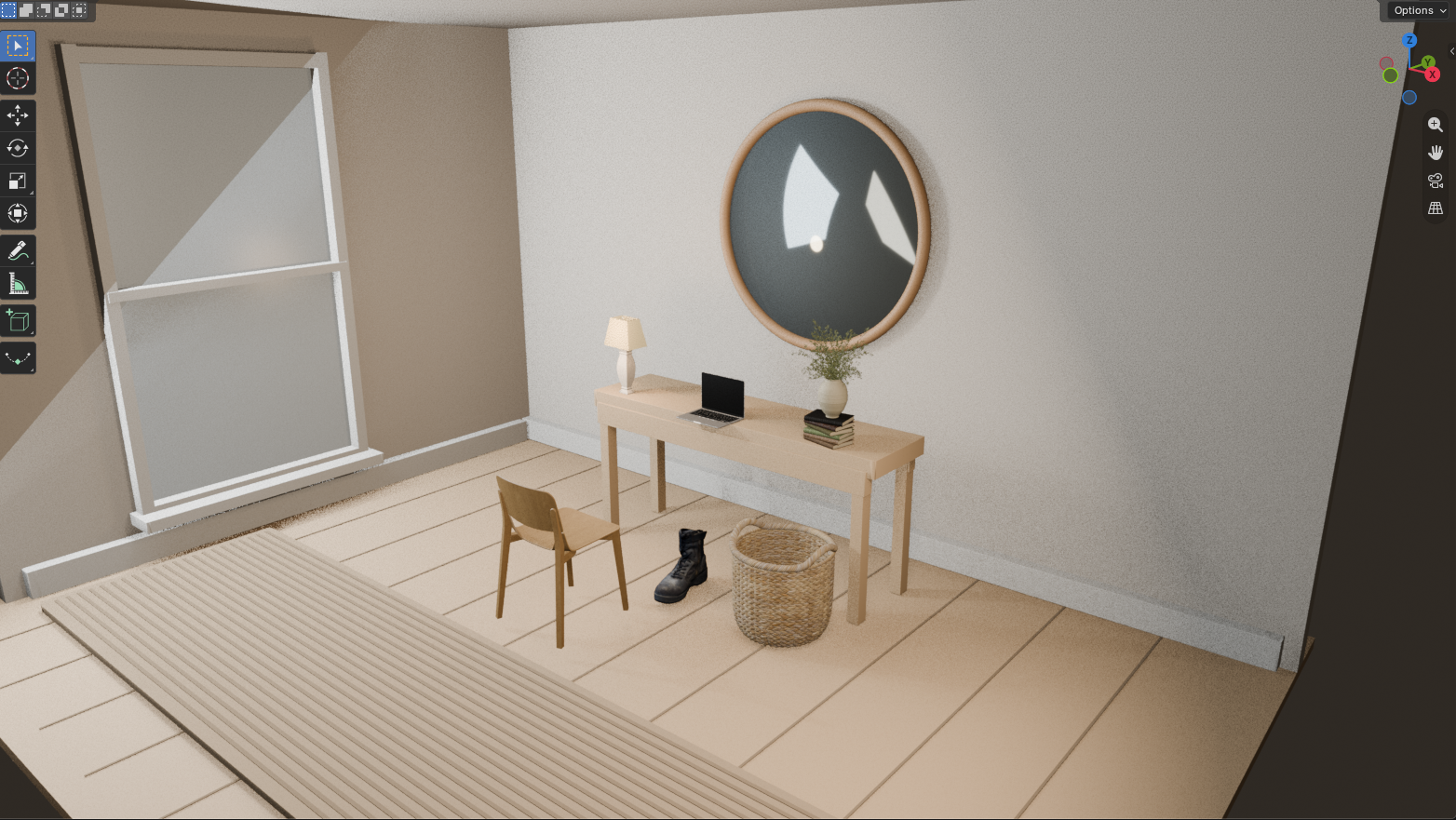
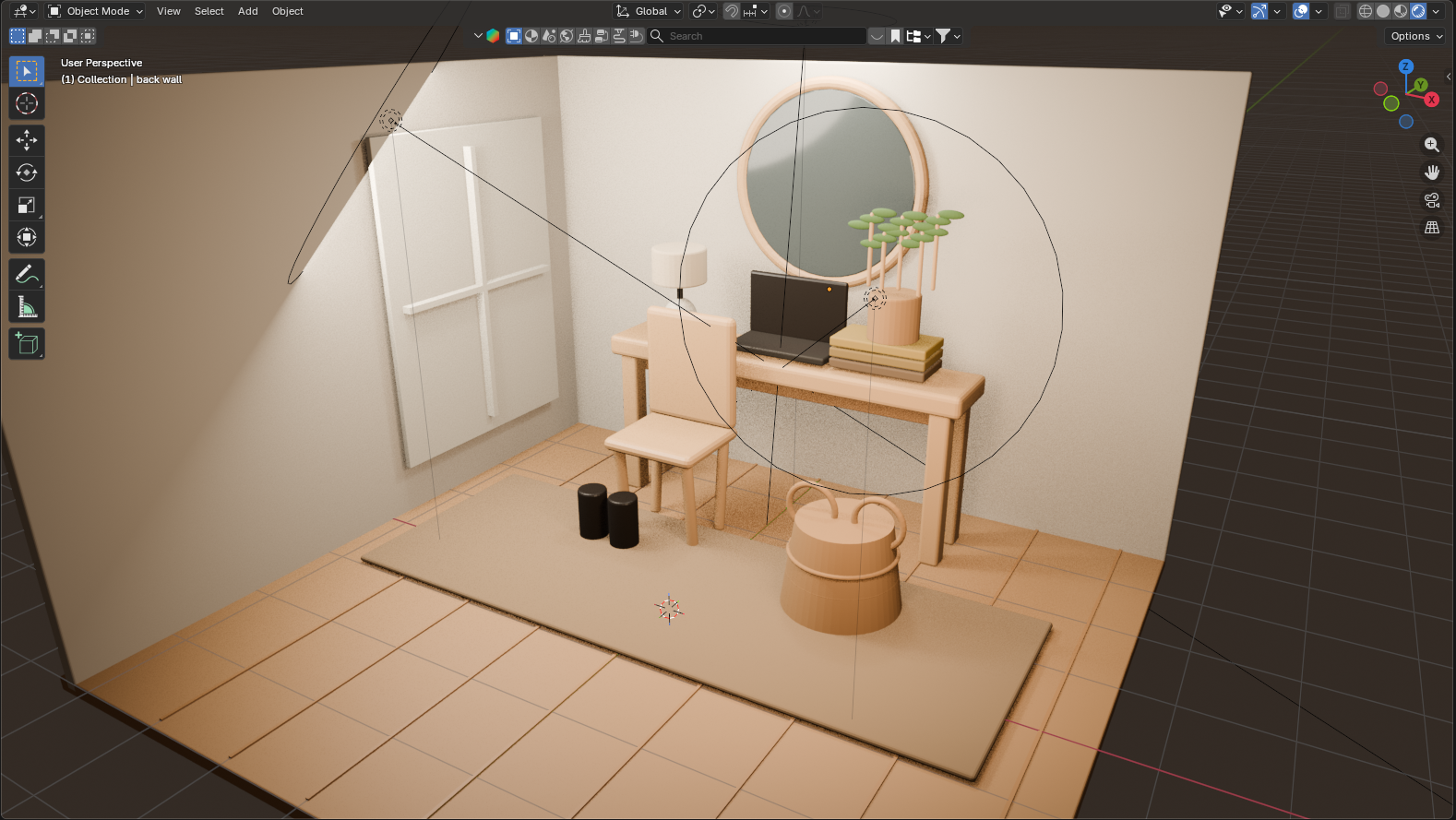
One reference task, shown without hiding the outputs.
This is one representative Scandinavian entryway comparison, not the entire benchmark. Both harnesses received the same reference objective and used OpenAI GPT 5.5 High. The aggregate quality claim still comes from the separate neutral LLM-judge rubric over seven live render pairs.

Architecture
Harness, inspectors, evidence loop, and baseline comparison
The current public architecture is a benchmark harness around Blender, not only a front-end product story. Harneloop is the open-source framework behind the evolving evidence and harness-improvement loop.
Measured system flow
Task prompts or image references pass through benchmark context preparation, the ViperMesh tool gateway, Blender scene generation, inspection, artifact capture, and final comparison against the Anthropic x Blender MCP server baseline.
Task prompt Scene request, constraints, or reference-image objective.
Context prep Benchmark setup and optional vector/RAG guidance.
Agent lane Agent runner or locally operated benchmark lane when provider quota required it.
ViperMesh MCP Deterministic Blender gateway and task-specific tool surface.
Blender addon Scene operations, support-aware placement, grounding, and render preparation.
Inspectors Scene, grounding, render, spatial, and command-trace checks.
Harneloop loop Evidence-driven harness evolution and retest promotion.
Comparison ViperMesh vs Anthropic x Blender MCP server baseline summaries.
How Harneloop contributed
Harneloop did not directly generate better scenes. It improved the harness and evidence loop so the agent could expose weaknesses, add better tools, and verify whether those changes improved benchmark outcomes.
- Evidence gating around scene, grounding, render, spatial, command-trace, and token artifacts.
- Gap detection for orientation errors, floating objects, support failures, and masked visual problems.
- General tool-surface improvements such as batch deletion, draped surfaces, support-aware relations, and grounding priority.
- Separation of live benchmark evidence from smoke/debug diagnostics.
- Repeatable case-study metrics that can be turned into public charts and review material.
Evidence completeness
The case study keeps evidence classes separate so public claims remain auditable.
| Evidence item | Value |
|---|---|
| Selected latest-per-label comparisons | 11 of 11 |
| Input comparison artifacts reviewed | 22 |
| Live and agentic comparison tasks | 7 |
| Smoke/debug diagnostic rows | 4 |
| Complete command-trace evidence | 11 of 11 |
| Missing command traces | 0 |
Template coverage
Case-study structure for reviewers
This page follows the same professional case-study template as PromptTriage, but keeps Part One focused on benchmark evidence rather than unfinished product claims.
Problem
Blender agents can appear capable while silently depending on broad code execution, fragile spatial guesses, and unverified render outcomes. The benchmark asks whether a purpose-built ViperMesh harness can make the agent faster, more deterministic, and easier to evaluate than the Anthropic x Blender MCP server baseline.
Context and constraints
The selected public comparison uses 11 latest-per-label artifacts from 22 source artifacts. Seven are live or agentic benchmark pairs. Four smoke/debug rows are retained for diagnostics, but they are not mixed into visual-quality claims.
Requirements
The harness needed repeatable command traces, scene inspection, grounding checks, visual review artifacts, reduced token usage evidence, and a clean separation between measured results and unfinished research notes.
Security and integrity model
The case study treats broad execute_code use as a control-surface risk and reliability smell. The ViperMesh path pushes agents toward narrower deterministic tools, evidence gating, command traces, and repeatable run artifacts.
Operations
Each benchmark run produces normalized JSON, command trace evidence, render artifacts, scene/spatial inspectors, and summary data suitable for reviewer-facing charts.
Cost analysis
Provider billable token cost is not yet complete. The current cost proxy is aggregate local acting-agent token telemetry across all seven benchmark runs, which is useful for efficiency comparison but should not be presented as provider billing data.
Tradeoffs
The harness improves determinism and evaluation quality, but it also introduces more tool surface area to maintain. The Anthropic x Blender MCP server baseline stayed slightly faster on one rotated-copy task, so the result is strong but not absolute.
Failure modes and lessons learned
The evidence loop exposed chair-orientation mistakes, floating objects, hidden support failures, camera-angle masking, and scene grounding problems that were hard to see from successful-looking renders alone.
What I would improve next
- Add provider billing telemetry so reduced token usage can be translated into real cost deltas.
- Run more image-reference tasks and expand the support-aware comparison set beyond one live pair.
- Repeat visual scoring with a stricter human-reviewed rubric and preserve side-by-side render panels.
- Extend the Harneloop evidence model across more task families, then publish independent case studies for each harness unit.
- Package the benchmark dashboard as a reusable reporting artifact for future agent-harness studies.